
On November 6, 2026, the National School of Development (NSD), Peking University and the Crawford School of Public Policy, the Australian National University (ANU), co-hosted the 203rd NSD Policy Talk & Deans' Forum at the Chengze Garden campus.
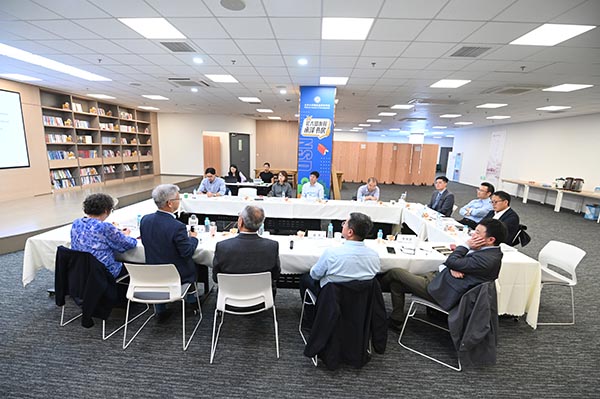
Bringing together scholars from leading universities across China and Australia, the forum took "China and the Global Economy: Structural Transition and Challenges in the Age of AI" as its theme, with discussions centered on economic growth and structural transformation in the AI era and the structural pressures now weighing on the world economy.
Jane Golley, Head of the Arndt-Corden Department of Economics at the Crawford School of Public Policy, delivered the opening remarks. Yiping Huang, Professor and Dean of NSD, and Ligang Song, Professor of Economics and Former Director of the China Economic Program at the Crawford School of Public Policy, gave the two lead presentations.
The panel session was chaired by Yu Sheng, Crawford Chair in Agricultural Economics and Deputy Head of ACDE at the Crawford School of Public Policy. Participants included Kunwang Li, Professor, Department of International Economics and Trade, School of Economics, Nankai University; Liqing Zhang, Professor, School of Finance and Director of the Centre for International Finance Research, Central University of Finance and Economics; Wei Si, Dean of the College of Economics and Management, China Agricultural University; Jun Yang, Professor, Department of Trade, School of International Trade and Economics and Director of the Digital Economy Laboratory, University of International Business and Economics (UIBE); Wei Chen, Associate Professor and Deputy Dean, School of Agricultural and Rural Development, Renmin University of China; Baodong Cheng, Dean of the National Academy of Economics and Trade for Forestry and Grassland, Beijing Forestry University; Xiaosong Wang, Professor, School of Economics, Renmin University of China; Gang Hu, Associate Professor and Deputy Dean, School of Asia-Australia Commerce, Liaoning University; and Shiro Armstrong, Director of International Partnerships, Director of the Australia-Japan Research Centre and Director of the East Asian Bureau of Economic Research at the Crawford School of Public Policy.
Opening Remarks
In her opening remarks, Golley welcomed the participants on behalf of the Crawford School and traced the history of the school and its long-standing research collaboration with NSD on the Chinese economy. She said she looked forward to continuing an in-depth exchange with Chinese scholars and to jointly producing valuable research.
Lead Presentations
The two lead presentations offered complementary lenses, a China perspective and a global perspective. Huang focused on economic growth and structural transformation of China, while Song examined the structural challenges facing the wider world economy.
Yiping Huang: China's Economic Growth and Structural Transition in AI Era
Huang argued that China's external imbalance is fundamentally a high-saving phenomenon, or "strong supply, weak demand." The widening surplus stems mainly from falling investment amid the property correction rather than weaker consumption, and "China Shock 2.0" reflects competitiveness, not state subsidies.
He warned that, echoing the historical "Engels' pause," AI could lift productivity while wages stagnate, and a substitution spiral replacing workers would sharpen inequality and the Matthew effect. He called for macro stimulus to address local debt and property risks, and longer-term structural reforms to lift household consumption and pursue mutual benefit, as China moves toward a more market-oriented, innovation-driven, consumption-reliant model.
Ligang Song: The Global Economy: Structural Challenges and Implications
Song's presentation, joint work with Yu Sheng, argued that the global slowdown is not a cyclical fluctuation but "the exhaustion of a growth regime." Conventional demand stimulus can stabilize the near term but cannot reverse the trend.
The core problem, he said, is that the forces of production have advanced while the relations of production have not, hindering the diffusion and sharing of innovation. He called for new production relations through stronger competition policy, portable benefits, taxation of capital and digital rents, wider technology access and a rebuilt multilateral order, and cited universal individual accounts as a new mode of distribution.
Panel Discussion
Following the lead presentations, the panel discussion, chaired by Yu Sheng, heard short presentations from Kunwang Li, Liqing Zhang, Wei Si, Jun Yang, Wei Chen, Baodong Cheng, Xiaosong Wang, Gang Hu and Shiro Armstrong. Topics included how AI is reshaping international trade, global supply chains and comparative advantage; global imbalances and international financial stability; the transformation of agriculture and forestry and rural incomes; the participation of the Global South in AI governance and rule-making; and Sino-foreign cooperative education. In the open discussion that followed, participants further exchanged views on how AI and digital transformation are reshaping productivity and trade in the Asia-Pacific, the implications of structural challenges for economic resilience and policy coordination, and opportunities for academic and research collaboration among the participating institutions.
The forum concluded with closing remarks from leaders of NSD and the Crawford School, followed by a group photograph with all participants.
NSD Policy Talk
Launched by NSD in 2013 as a key initiative toward building a strategic think tank, the NSD Policy Talk invites experts and scholars from China and abroad to share insights through lectures, dialogues, roundtables and forums, examining public policy choices through rigorous inquiry and contributing to China's reform and development.
National School of Development
The National School of Development is Peking University's multidisciplinary school grounded in economics. Its predecessor, the China Center for Economic Research, was founded in 1994 by six scholars led by Justin Yifu Lin and renamed NSD in 2008. Upholding the university's tradition of intellectual freedom and inclusiveness, the school integrates teaching, research and policy work. Its teaching spans government, business and academia; its research meets global scholarly standards to tell China's story and advance new theory; and its think tank, among China's first high-end think tanks, focuses on the key challenges of reform and offers influential policy recommendations. Committed to a "small institution, broad network" approach, NSD serves as an important platform for China's international exchange and cooperation.
Written by: Yao Bai
Edited by: Xianqing Wang